
Most Recent Public Meeting
On Sunday May 31st, 2026 project partners held a public meeting to share updates on the status of the Topanga Lagoon Restoration Project following the fires of 2025. If you were unable to join us in-person or virtually, you can watch a recording of the meeting via YouTube.
Project support generously provided by:

Recovery Planning for Topanga State Park & Will Rogers State Historic Park
Find out more about this interconnected planning effort
A portion of the Topanga Lagoon Restoration Project is located in lower Topanga State Park, and all California State Parks facilities within the project area were destroyed by the Palisades Fire in 2025. State Parks is planning the next steps in recovery by conducting a public engagement process and developing guiding principles and priorities for the future of both Topanga State Park and Will Rogers State Historic Park. The multi-agency-led Topanga Lagoon Restoration Project is coordinating with State Parks on the recovery planning effort at Topanga State Park.
Visit the recovery planning website to participate and sign up for email updates.
PROJECT OVERVIEW
The Resource Conservation District of the Santa Monica Mountains, along with California State Parks, Caltrans, and County of Los Angeles Department of Beaches and Harbors, are working on a joint project to restore Topanga Lagoon, provide improved visitor services, coastal access, and emergency response, while proactively addressing sea level rise. The Topanga Lagoon Restoration Project has been many years in the making and has been generously supported by the Wildlife Conservation Board, State Coastal Conservancy, the California Department of Fish and Wildlife and through the efforts of former Assemblymember Richard Bloom, among others.
A Brief History of the Lagoon
Topanga Lagoon is located at the mouth of Topanga Creek, within Topanga State Park and Topanga Beach at the eastern edge of the Santa Monica Mountains. Once containing 30 acres of pristine wetlands, Topanga Lagoon has been whittled down to less than 1 acre due to long-term development patterns. By restoring Topanga Lagoon in a coordinated and proactive way, we can preserve this haven of unique biological, cultural and recreational resources, while improving existing public infrastructure. The Topanga Lagoon Restoration project provides an opportunity to enhance coastal access, expand recreation opportunities, and develop buffers for projected sea level rise.
Project Goals
The Topanga Lagoon Restoration Project seeks to protect and improve the biological, cultural and recreational values onsite. The project does this by expanding Topanga Lagoon from its current footprint of less than 1-acre, restoring and enhancing coastal habitats and reconstructing the Pacific Coast Highway (PCH) bridge to accommodate a wider lagoon. The project will improve visitor services and coastal access by developing a “Gateway Corner” visitor hub with interpretive features and new parking at NW corner of the intersection of the PCH and Topanga Canyon Boulevard. Public lands within the project area will also be better connected through an integrated trail system, emergency response, improved parking, and new visitor amenities.

Cooper Auto Camp established 1924

Looking west over the Topanga Lagoon in the 1900’s prior to extensive development – photo from the Santa Monica Public Library
Selected Project Design
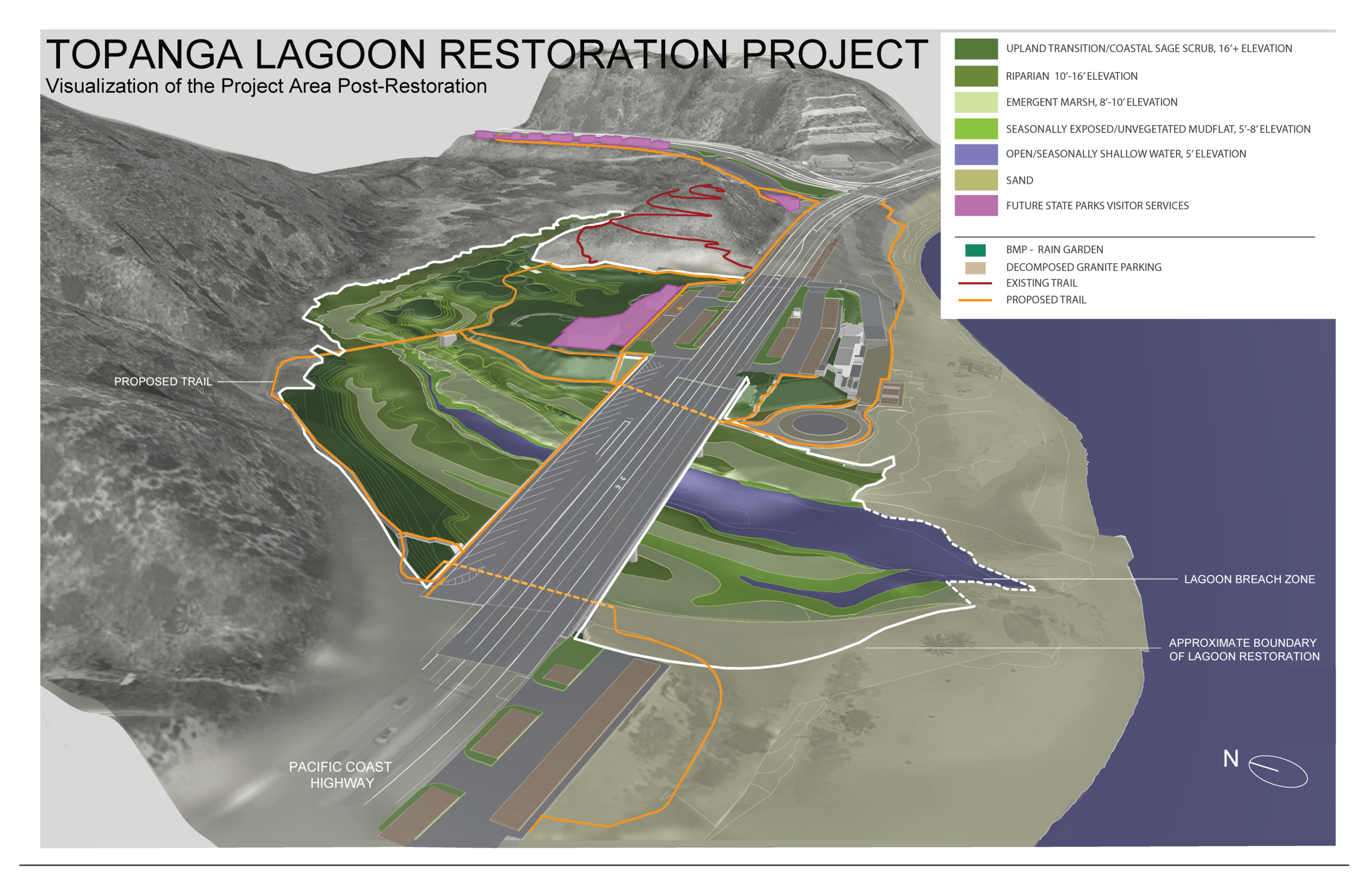
The FEIR identified Hybrid Alternative 3A as the selected alternative and addresses the challenges and threats to onsite biological and cultural resources while expanding and improving coastal access, recreation, and visitor amenities. Alternative 3A also proactively addresses sea level rise (SLR) and the related threats to coastal infrastructure and ecosystems.
This selected alternative replaces the 79’ long Caltrans Pacific Coast Highway (PCH) bridge with one that is 440’ long, allowing the expansion of the lagoon/creek habitat to increase to 8 acres, providing more refugia for endangered tidewater goby and steelhead trout. This design also creates ~1 acre of additional beach habitat and enhances 30+ acres of native habitat.
Unified trail, parking, and emergency response systems will be improved and developed for the entire project area.
Visualization of Topanga Lagoon, Canyon & Beach post restoration. Credit: Michael Sotona May 2026
WHERE TO LEARN MORE
The RCD actively invites the public to be involved in the planning and restoration of this important area. Read more about the restoration, get current updates, and discover how you can become involved at the project’s full website at TopangaLagoonRestoration.org
WE MADE A MUSIC VIDEO!
In an effort to invite as many diverse voices into the restoration process as possible, we have created a music video featuring Topanga Lagoon!
Watch the video below and join a young boy’s journey as he experiences the beauty and wonder of Topanga Lagoon through the eyes of an endangered southern steelhead. Please share the video and help us spread the word about this exciting restoration!